Amazon Arbitrage India in 2026: Step-by-Step Guide to Sourcing and Flipping Products for Profit
Amazon 101

Amazon Arbitrage India in 2026: Step-by-Step Guide to Sourcing and Flipping Products for Profit

Written by Naveen Kumar Nutheti
4 April, 2026|15 min read
Share

Amazon arbitrage in India offers a way to sell on Amazon without the headache of creating your own product. The trick? Find branded products for cheap—at local stores, wholesale markets, or through other platforms—then list them for a higher price on Amazon and pocket the difference after all those fees. By 2026, Amazon India has more than a million active sellers, and the arbitrage model still works if you stay on top of margins, sourcing, and all those fee calculations. This guide walks you through everything—from picking your first winning product to getting it shipped to an Amazon fulfillment center.

Key Takeaways
Amazon arbitrage is simple: buy branded products for less, then resell them on Amazon at a higher price.
Every product needs to hit three targets — a 3x price multiple, a Best Sellers Rank (BSR) under 50,000, and a net margin over 25% after Amazon fees.
This guide breaks down both sourcing models and how to calculate real profit.
Learn where to source products across India and the most common mistakes that can wipe out your margins.

Two Models Every Seller Must Understand

Before you start sourcing, get clear on what arbitrage means here. You're buying something at a lower price in one place and selling it for more somewhere else. When it comes to Amazon, that means you find branded products cheaper than their Amazon price, list them, and sell at the higher price. In India, sellers have two main models.
Retail Arbitrage
Retail arbitrage means you get products physically — from D-Mart clearance, Big Bazaar seasonal sales, or wholesale markets like Sadar Bazaar (Delhi), Crawford Market (Mumbai), and Chickpet (Bengaluru). When you buy in bulk, prices hit 30–60% below MRP. Margins are solid, mainly because these deals aren't advertised online. But you've gotta travel and spend time hunting.
Online Arbitrage
Online arbitrage is all digital. You look for products on Flipkart, Meesho, or IndiaMart priced lower than on Amazon India. It's easy to scale and you're not spending your days walking markets, but price gaps close pretty fast. Once a product gets popular, the price gap usually disappears within 30–45 days.
FactorRetail ArbitrageOnline Arbitrage
SourcingPhysical stores, wholesale marketsFlipkart, Meesho, IndiaMart
Startup Capital₹15,000–₹50,000₹5,000–₹20,000
Margin Potential30–60% per unit10–30% per unit
CompetitionSlower — manual sourcingFaster — anyone finds same deal
ScalabilityLimited by travel and timeHighly scalable with tools

How to Find Profitable Products for Amazon Arbitrage

Most sellers lose money only because they buy without checking price history or fees. Qualify every product before you buy.
The 3x Rule — Your First Filter
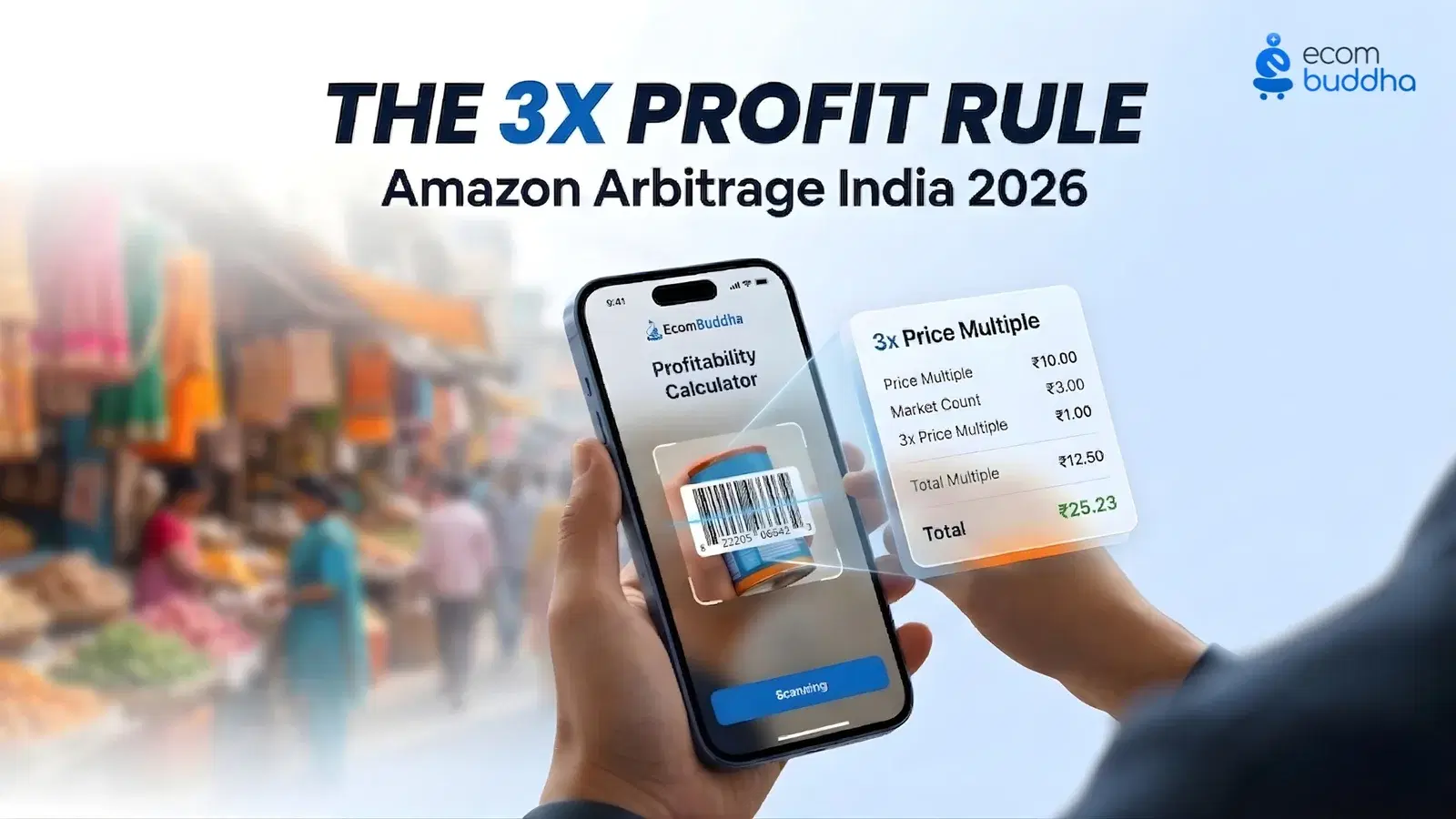
You need to sell on Amazon at a price at least 3x what you paid. That covers Amazon's referral fee (8–20% depending on category), FBA fulfillment fees (₹35–₹150 per unit), and return handling, and still leaves you with 15–25% net margin. Most products that don't hit the 3x rule eventually lose money. If you can't get it at 3x your buy price, walk away.
3 Tools to Use Before Every Purchase
Keepa: Track Amazon India's price history for any ASIN. Only buy if the price has stayed steady for 60 days; sudden spikes usually drop back in a couple of weeks.
Amazon Seller App: Scan barcodes in-store and see current selling price, BSR, and estimated sales. It's free if you're registered.
Amazon Revenue Calculator: Plug in the ASIN and your buy price at sellercentral.amazon.in. It spits out your real net profit after every fee.
Best Categories in 2026
Amazon arbitrage works best in Home & Kitchen, Tools & Hardware, Stationery, Toys, and FMCG consumables. These categories have steady repeat purchases, reliable BSRs, and less risk of IP complaints compared to fashion or electronics. Don't touch restricted brands like Nike, Lego, or Hasbro unless you're approved — Amazon will pull your listings and possibly restrict your account.
Need help auditing your Amazon listings or setting up your FBA sourcing?

EcomBuddha's catalog team works with sellers in tools, FMCG, home goods, and hardware.

Request a free listing audit today

How to Calculate Your Exact Profit — The Amazon Arbitrage Calculator

Don't just guess your margins. The Amazon Revenue Calculator inside Seller Central does all the math for you and includes every fee. Run it for each product before placing your order.
Net Profit = Selling Price − Buy Price − Referral Fee − FBA Fulfilment Fee − Shipping to FBA
Worked Example:
Sell Price: ₹499 | Buy Price: ₹120 | Referral Fee: ₹40 (8%) | FBA Fee: ₹55 | Shipping to FBA: ₹20
Net Profit = ₹499 − ₹120 − ₹40 − ₹55 − ₹20 = ₹264 per unit | Net Margin: 52.9%
Fee TypeHow It WorksTypical Range — Amazon India
Referral FeePercentage of selling price, based on categoryTypically 8–12%, but can be higher or lower
FBA Fulfillment FeeDepends on size and weight₹35–₹150 per unit for standard-size products
Closing FeeFlat fee for select categories₹2–₹25 per item for media and FMCG
Shipping to FBAYour cost to send inventory to Amazon FC₹10–₹25 per unit in bulk
Expect about a 5–8% return rate in most categories. The Revenue Calculator pulls current fee data and keeps your margins honest — not what spreadsheets guess.

Online Arbitrage Step-by-Step: Sourcing From Flipkart and Meesho

Here's how sellers pull in ₹2–5 lakh a month flipping products online. It's a five-step routine:
Open Flipkart or Meesho. Choose a familiar category — start with Home & Kitchen or Tools. Sort by popularity, see what's moving.
Copy the product name, search it on Amazon India. Compare the prices. If the Amazon price isn't at least 3x your source price, move on.
Check the ASIN on Keepa. If the Amazon price holds steady for 60+ days, you've got a genuine gap. If not, wait — it'll drop back.
Confirm the BSR. Under 50,000 in big categories means steady sales. Over 200,000? Slow mover, unless your margin is very high.
Run the Revenue Calculator with your buy price. If net margin is above 25%, order a test batch of 5–10 units before you go big.
Always do a test batch first — Meesho and similar platforms can ship the wrong variant or damaged goods. Check quality before investing.

Retail Arbitrage India: Best Physical Sourcing Locations by City

If you're doing retail arbitrage, you want physical gaps — places where products are cheap in-store but expensive online. These Indian cities and markets consistently deliver:
CityBest Sourcing LocationTop Categories
Delhi / NCRSadar Bazaar, Nehru Place, Lajpat Rai MarketTools, hardware, electricals, stationery
MumbaiCrawford Market, Dharavi wholesale, UlhasnagarToys, home goods, FMCG
BengaluruCommercial Street, SP Road, ChickpetElectronics accessories, stationery, tools
HyderabadLaad Bazaar, Begum BazaarHome kitchen, FMCG, handicrafts
Surat / AhmedabadRing Road wholesale markets, APMC Market, Rander Road textile hubsHome textiles, small appliances, stationery, FMCG
Nationwide, D-Mart and Big Bazaar clearances are fantastic. Go after a season or post-sale — brands dump excess stock at 40–70% under MRP. Items are new, genuine, and Amazon FBA accepts their barcodes.

Four Amazon Arbitrage Mistakes That Will Destroy Your Margins

Avoid these blunders — they're common and costly, but easy to spot.
Mistake 1 — Ignoring the Full Fee Stack
People think profit is just selling price minus buy price. Nope — Amazon takes ₹80–₹120 in fees on a ₹499 item. If you buy at ₹350 and sell at ₹499, you're losing money. Always run the Revenue Calculator.
Mistake 2 — Selling IP-Protected Brands Without Approval
Brands like Lego, Nike, and Hasbro clamp down hard. One complaint, your listing disappears, possibly your whole account too. Check in Seller Central if approval is required before buying.
Mistake 3 — Buying at the Peak of a Price Spike
If Keepa shows a ₹699 product was averaging ₹399 for months, don't buy it at ₹699 — a price correction will leave you stuck with loss-making inventory. Only buy if recent prices have been stable for 60 days.
Mistake 4 — Missing FNSKU Labels on Resell Stock
From 31st March 2026, Amazon ditched commingled inventory in India. Every reseller using Amazon FBA India must print and stick FNSKU labels over EAN barcodes before shipping to FBA. Otherwise, your stock gets rejected. Print labels in Seller Central before shipment.

How to Scale Amazon Arbitrage India to ₹1 Lakh Monthly Revenue

Ten profitable orders prove the model. Getting past ₹1 lakh each month takes a solid sourcing checklist, tracking every ASIN, and reinvesting. It's not about finding secret products — it's about running the same steps every time.
Stick to your checklist: 3x price multiple; BSR under 50,000; no brand restrictions; 25%+ margin; 60-day Keepa price stability. If a product fails any step, skip it.
Track every ASIN — buy price, sell price, units bought/sold, margin per unit, days to sell. After two months you'll know which categories work best, so stick with those.
Reinvest about 80% of profits for the first six months. With ₹10,000 starting capital, 25% net margin, and a 30-day sell cycle, you can reach ₹50,000+ monthly revenue in four months.
Once you have 20+ active ASINs, automate repricing — tools like SellerApp keep you winning the Buy Box without manually tracking every listing.
Amazon arbitrage India is still working in 2026, as long as you follow the 3x rule, run every sourcing decision through fees, and comply with FNSKU labeling. Start with one model, validate results with ten profitable orders, then scale up. The sellers making ₹1 lakh a month aren't chasing hidden products — they're just running the same checklist for every deal.

Frequently asked Questions

Naveen Kumar Nutheti

Naveen Kumar Nutheti is a seasoned e-commerce strategist with 12+ years of experience across India and the Middle East. He has scaled businesses past ₹1,000 Cr in annual revenue and consults brands including Godrej, Nippon Paint, Kohler, Havells, Taparia, and Birla Opus on e-commerce sales strategy and product listing optimisation. He is the founder of EcomBuddha, an AI-powered listing intelligence platform for Amazon India sellers.

© Digicom Buddha Tech pvt ltd. All rights reservedPrivacy PolicyTerms of Service