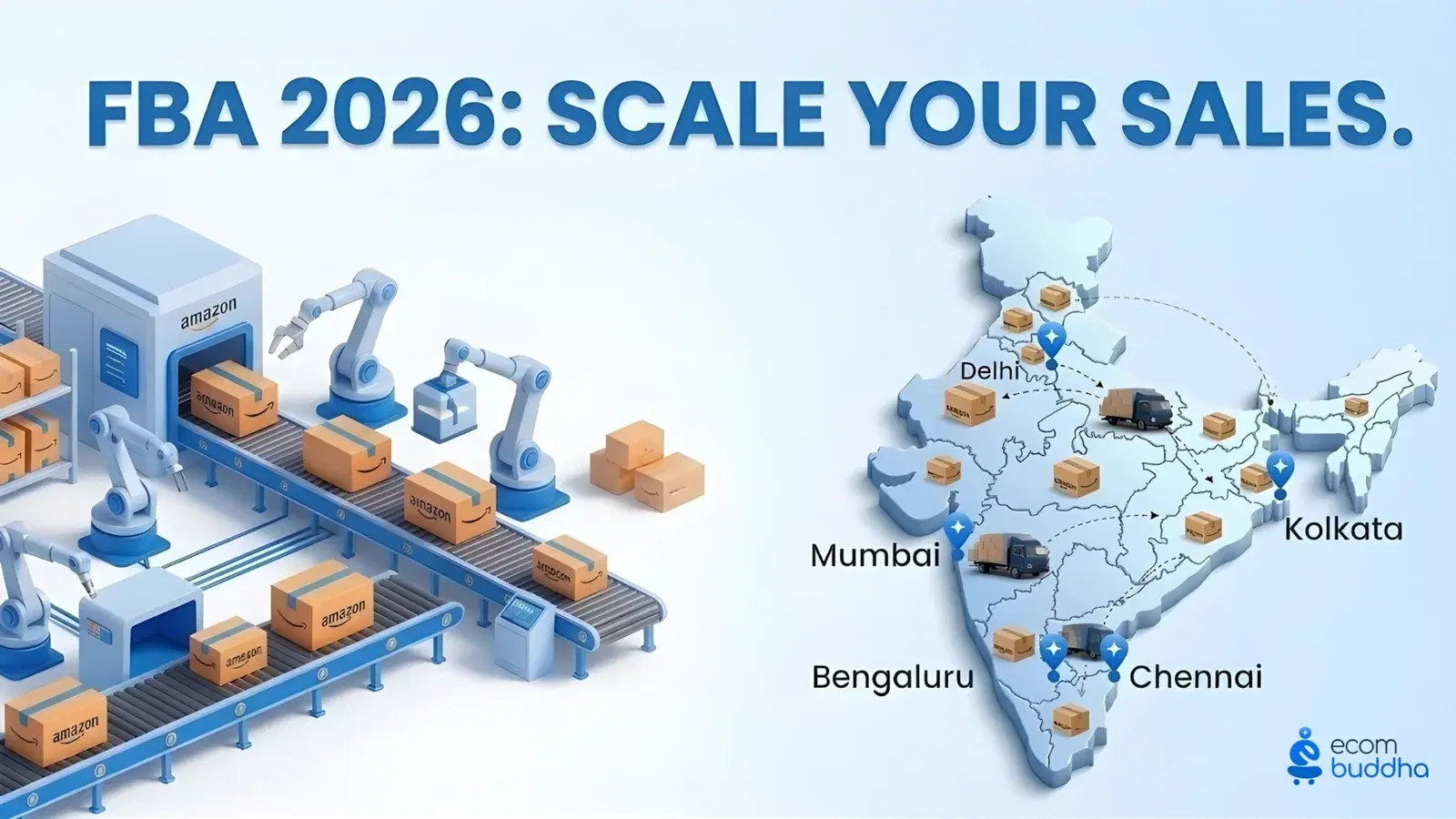
Amazon 101
FBA Full Form: What Amazon FBA Means, How It Works, and Whether It's Right for Your Business in 2026
If you're selling on Amazon India in 2026, you'll keep running into 'FBA.' Now, if you're looking for the FBA full form, it's simply Fulfillment by Amazon. But it's much more than just a name—it's a system where instead of you worrying about inventory or packing boxes, Amazon handles the dirty work.
Key Takeaways
FBA stands for Fulfillment by Amazon — Amazon handles storage, packing, delivery, and even returns on your behalf.
In India, FBA fees run anywhere from ₹40 to ₹150 or more per item, depending on size and weight.
This guide breaks down how FBA actually works and what it really costs.
Find out how to decide if FBA makes sense for your business in 2026.
FBA Full Form — Quick Answer
FBA stands for Fulfillment by Amazon. You send your stuff to an Amazon warehouse; they store it, pack it, ship it, and handle any returns or customer problems.
In plain English: You sell → Amazon delivers.
What Is Amazon FBA and How Does It Work?
Fulfillment by Amazon (or FBA) shifts most logistics off your plate. Here's the basic flow:
Ship your inventory to Amazon.
Amazon holds onto it until someone orders.
Customer places an order.
Amazon packs and ships the item.
They handle returns and customer service, too.
Does it bring results? Absolutely.
| Metric | Value |
|---|---|
| FBA conversion rate | 10–18% |
| Non-FBA conversion rate | 5–8% |
| Buy Box win rate increase | +20–40% |
So, it's not just convenience; it actually bumps up your sales.
Amazon FBA in India — How It Works in 2026
Amazon's network in India is massive now — more than 70 fulfillment centers in all the big cities.
| Metric | Value |
|---|---|
| Prime delivery | 1–2 days |
| Standard delivery | 2–5 days |
| Return handling | 100% Amazon-managed |
Why do sellers love it?
Faster shipping means more trust (and sales).
The Prime badge pulls in more clicks and conversions.
You can reach customers in Tier 2, Tier 3 cities — FBA handles the heavy lifting.
So even if you're in Delhi, you can send to Chennai in a day or two with FBA.
Amazon FBA Fees in India
Here's what you'll actually pay:
| Fee Type | Cost Range |
|---|---|
| Fulfilment fee | ₹40 – ₹150+ |
| Storage fee | ₹20 – ₹45 per cubic ft/month |
| Referral fee | 5% – 20% (category dependent) |
| Closing fee | ₹10 – ₹50 |
FBA fee by weight:
| Weight | Fee |
|---|---|
| 0–500 g | ₹40 – ₹70 |
| 500 g – 1 kg | ₹70 – ₹110 |
| 1–2 kg | ₹110 – ₹150+ |
But wait — don't forget the sneaky stuff:
You'll spend 10–25% of revenue on ads
Returns eat up 5–15%
Some inventory gets damaged/lost: 1–2%
Total real cost often sits at 40–55% of your selling price. Always check the newest fee table in Seller Central's FBA Revenue Calculator. Amazon tweaks rates a lot.
Amazon FBA Calculator India — Profit Reality
Real-life breakdown: You sell something for ₹1,499. Product cost you ₹700.
Amazon's cut (referral + FBA + closing): ₹510
Your cost to source it: ₹700
Your actual profit: ₹289 (about 19%)
So, you might expect ₹500, but by the time you add everything up, it's ₹289. That's a 40% drop after real-world costs. Always crunch the numbers before you send stock to FBA.
Let Your Product Page Do The Selling
Try EcomBuddhaFBA vs Self-Fulfillment — Which One Is Better?
Direct comparison:
| Metric | FBA | Self-Fulfillment |
|---|---|---|
| Conversion rate | 10–18% | 5–8% |
| Delivery speed | 1–2 days | 3–7 days |
| Buy Box win rate | High | Medium |
| Operational effort | Low | High |
| Margin | Medium (fees apply) | High (no FBA fees) |
Want to sell more? FBA wins. Want fatter margins? You may like self-shipping, but you'll work more for each order.
Run the math:
FBA: ₹200 profit × 150 orders = ₹30,000
Self-fulfill: ₹300 profit × 80 orders = ₹24,000
FBA gets you higher total profit just from volume — even if the per-item margin is lower.
Advantages and Disadvantages of Amazon FBA
Advantages
The Prime badge alone boosts clicks by 20–30%
Faster shipping = more repeat buyers (up 15–25%)
Automate 70–90% of your daily grind
Sell in 100+ cities without a courier network
Returns and customer headaches? Amazon takes it.
Disadvantages
About 25–45% of your revenue goes to Amazon once you add everything up
If your inventory sits longer than 3–6 months, storage penalties kick in
Returns can cut profits by another 5–10%
You lose control over packaging (so, no fancy unboxing videos)
Is Amazon FBA Right for Your Business?
The Golden Rule: Selling Price ≥ 2.5 × Product Cost
Example — minimum viable selling price:
| Product Cost | Minimum Selling Price |
|---|---|
| ₹300 | ₹750+ |
| ₹500 | ₹1,250+ |
| ₹800 | ₹2,000+ |
Why? Because Amazon takes 25–35%, ads take 10–20%, returns/damage eat up 5–10%. Overall, plan for 40–55% of the sale price getting swallowed up. The 2.5× rule means you'll actually see a profit.
| FBA works if... | FBA fails if... |
|---|---|
| Gross margin ≥ 30% | Margin < 20% |
| Lightweight product | Bulky or heavy items |
| Selling price ₹500–₹3,000 | Low-ticket items under ₹300 |
| High demand, fast-moving | Slow-moving or seasonal inventory |
Conclusion
Fulfillment by Amazon is the fastest way to scale your Amazon India operation. You convert more shoppers (10–18%), do a lot less manual work (save 70–90% of your time), and deliver at Prime speed. It's not always pure profit, though — your product, pricing, and margins have to match. If you're keeping north of 30% margin on products in the ₹500–₹3,000 slot, and items move quickly, FBA can seriously boost your business. But if your numbers are thin, fees will eat your profits before you even get started.
Frequently asked Questions

Naveen Kumar Nutheti is a seasoned e-commerce strategist with 12+ years of experience across India and the Middle East. He has scaled businesses past ₹1,000 Cr in annual revenue and consults brands including Godrej, Nippon Paint, Kohler, Havells, Taparia, and Birla Opus on e-commerce sales strategy and product listing optimisation. He is the founder of EcomBuddha, an AI-powered listing intelligence platform for Amazon India sellers.
Table of Contents
See how EcomBuddha can grow your Amazon India business.
Related Blogs

Amazon Seller Strategy
Amazon Private Label 2026: How to Build Your Own Brand and Grow on Amazon
6 April, 2026
Amazon 101
Amazon Arbitrage India in 2026: Step-by-Step Guide to Sourcing and Flipping Products for Profit
4 April, 2026
Amazon Listing Optimisation