What is an ASIN? How IDQ Scores Impact Amazon Listing Performance
Amazon 101

What is an ASIN? How IDQ Scores Impact Amazon Listing Performance

Written by Naveen Kumar Nutheti
12 April, 2026|13 min read
Share

Every product on Amazon India is tagged with a unique ASIN — its digital identity card inside Amazon's catalogue. But owning one isn't enough. This guide breaks down how the Item Data Quality (IDQ) score works, why it's the biggest lever behind seller growth, and how Indian sellers can use it to drive visibility, conversions, and rank on Amazon India in 2026.

Key Takeaways
An ASIN is Amazon's unique 10-character code that anchors your product's identity, reviews, and sales history on Amazon India. A listing built on weak data stays invisible — no matter how good the product is.
The Item Data Quality (IDQ) score is measured out of 100 and tracks how complete and accurate your product data is — ensuring the right information reaches the right buyer at the right time.
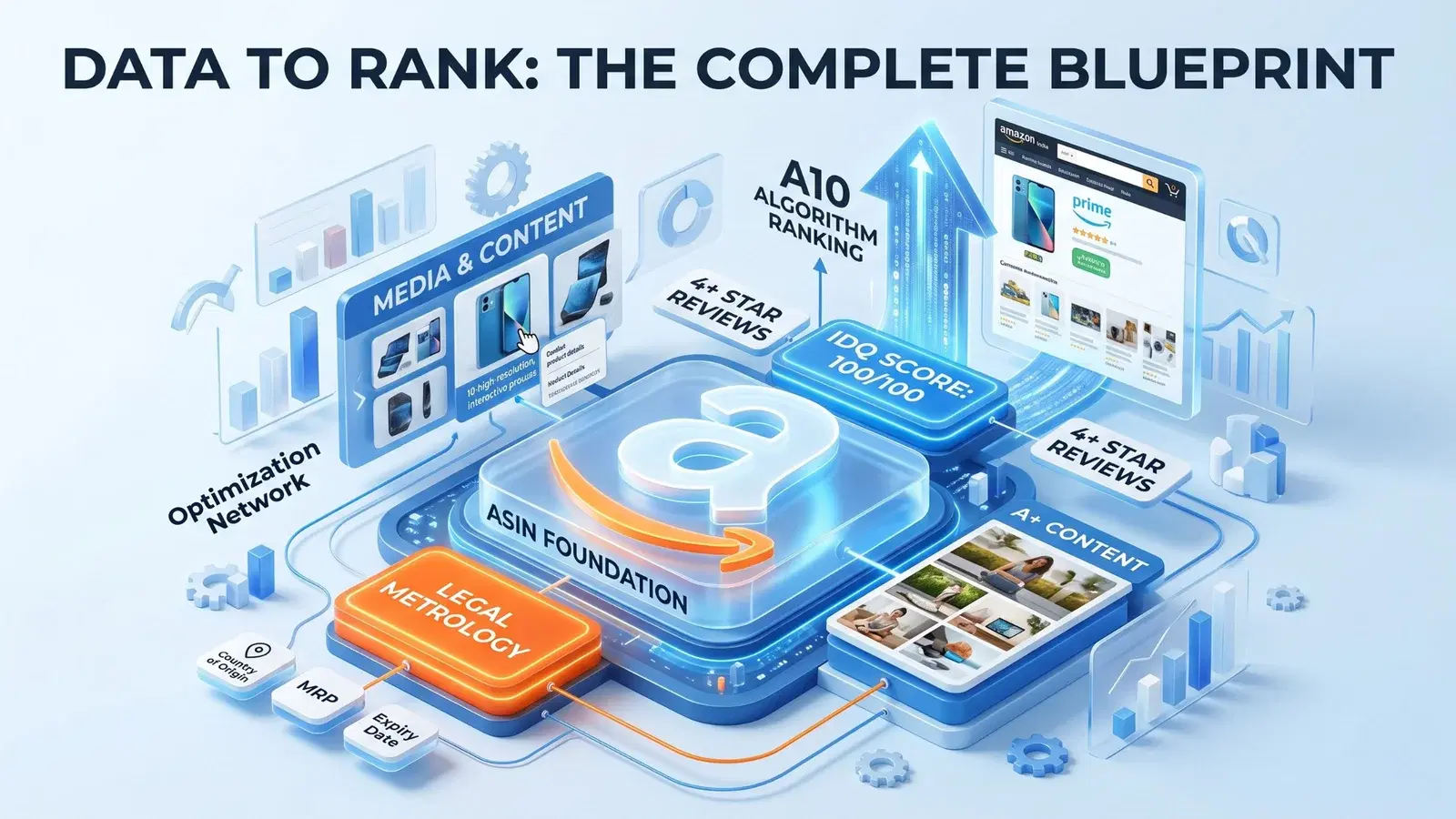
Indian sellers must comply with Legal Metrology fields (Country of Origin, MRP, Expiry Date) — skipping them doesn't hurt your IDQ score but it can expose you to legal action under the Packaged Commodities Rules.
Per Amazon's own published guidance, Infographics and A+ Content can lift conversions by 3–10% on average, with Premium A+ pushing that up to 20%.
Localised "Hinglish" keywords and mobile-first title front-loading (first 60 characters) are essential for ranking on Amazon India.
IDQ compliance gets you found, but persuasive copy, strong reviews (4+ stars), and Brand Registry protection are what actually convert and retain rank.

Why Listing Quality Decides Who Wins on Amazon India

India's online shopping market has turned into an all-out scramble. According to Couponsly's 2025 Amazon India statistics, Amazon India now serves over 150 million active users, and lakhs of sellers on the platform are elbowing for the same attention — visibility is what decides who wins. Every product on the platform is tagged with a unique ASIN, which works as its digital identity card inside Amazon's catalogue. But owning one isn't enough. A poorly built listing means customers will never find your item in the first place.
This is where Amazon's Item Data Quality (IDQ) score steps in. Think of it as a health check-up for your listing — it shows how complete, accurate, and well-structured your product data really is. Every item in the catalogue has an identifier, but only listings backed by solid data are actually built to convert. In this guide, you'll see how listing quality affects your rank on Amazon India and why the IDQ score is the biggest lever behind seller growth.

Decoding the Fundamentals: What is an ASIN and Why Does It Matter?

Before we get into quality scores, let's nail down the basics of how Amazon runs in the background. The term stands for Amazon Standard Identification Number, and it's essentially the digital fingerprint of every item on the platform — with hundreds of millions of ASINs active across Amazon's global catalogue.
What the Term Really Means in the Amazon Ecosystem
This code isn't some ordinary product number; it's closer to the DNA of your product. For books, it usually matches the ISBN-10, but for everything else, Amazon generates a fresh one the moment you create a listing. This prevents duplicate pages for the same item and keeps all your reviews and sales history tied to the right variation. For sellers on Amazon India, protecting this identifier through Brand Registry is non-negotiable — without it, "listing hijackers" can ride on the success of products you built from scratch.
How It Works Inside Seller Central
Think of the identifier as the anchor of your Seller Central account. Everything — your Buy Box wins, organic rank, advertising data, and sales history — is stitched to that single code. Learning how to build a fresh listing the right way is the first step toward keeping all that data intact.
Protect Your ASIN

The strongest defence against content tampering is a listing built to Amazon's exact standards — correct attributes, complete data, no gaps a hijacker can exploit. EcomBuddha generates fully compliant listing copy so your product page has no weak spots.

Build a listing Amazon can't flag — Try EcomBuddha

Why Amazon Mandates a Higher IDQ Score

Every product category on Amazon comes with a set of required and recommended attributes — the baseline information a buyer needs before they can commit to a purchase. Amazon built the IDQ scoring system to track exactly this: which ASINs are providing the right data, and which ones are leaving shoppers in the dark.
A Hand Tool, for instance, must cover material, size, and colour as mandatory fields, and is strongly encouraged to also include details like application type and whether the product is weatherproof. The more complete and relevant the data, the more confidently Amazon's algorithm can match your product to the right search query — and the better your chances of showing up in front of a buyer who is ready to purchase.

Getting to Know Your Amazon IDQ Score

Think of the Item Data Quality (IDQ) score as Amazon's report card for the way you've put together your product page. Scored out of 100, it tells the algorithm whether your listing is ready to be pushed into the spotlight or still needs work before it can compete.
What Actually Goes Into Your IDQ Score?
Amazon weighs several areas while calculating your IDQ. The most important ones include:
Sharp, high-resolution images (the main image must have a pure white background)
A keyword-rich, policy-compliant title within character limits
Detailed, benefit-led bullet points covering key product attributes
Mandatory category-specific fields (material, size, colour, and more depending on the product type)
How a Weak IDQ Score Hurts Your Best Seller Rank
What does a weak IDQ score actually cost you? Think in terms of your Best Seller Rank (BSR). A complete, accurate listing builds buyer confidence and lifts conversions. Better conversions push your BSR higher. A stronger BSR earns better organic visibility inside Amazon India's search results. And more visibility means more sales — with fewer returns and negative ratings eating into your margins. IDQ isn't just a data checklist; it's the starting point of a flywheel that drives your entire ranking engine.
Clean LQD Weekly

Every Quality Alert on your Listing Quality Dashboard is a ranking penalty waiting to happen. EcomBuddha's Catalogue Health tool surfaces exactly what's incomplete or non-compliant across your ASINs — so you know what to fix before Amazon suppresses it.

Audit your catalogue health now — Check on EcomBuddha

The Direct Link Between Listing Quality and Your ASIN Amazon Ranking

It's easy to assume that strong sales alone guarantee a good rank. Sales matter, yes — but Amazon's newer A10 algorithm puts huge weight on relevance and on having complete, accurate data for every product in the catalogue.
The Secret to Lifting CTR With High-Quality Data
High-resolution photos and a polished listing builds credibility amongst shoppers. Industry split-testing has consistently shown that sellers who add more high-quality product images along with infographics outperform those relying on 2–3 basic shots. When your attributes data is complete, it builds instant trust and gets shoppers to click. A higher click-through rate is how Amazon reads relevance — and relevance drives rank.
We put this to the test with our own survey of 100+ Indian shoppers. Nine out of ten said that high-quality images, clear infographics, and strong reviews made their buying decision faster and more confident. Three out of four told us they did not return products purchased after seeing a well-built listing. Listing quality isn't just an SEO lever — it's a direct sales driver.
Conversion Rate (CR) as a Ranking Factor
Informed buyers convert better. Accurate dimensions, material details, and proper usage notes cut down on buyer hesitation and lift conversion rates. It also slashes returns, and since Amazon punishes sellers with high return rates, fixing your IDQ is one of the simplest ways to protect your search position over the long haul.
Amazon's Search Algorithm and Data Completeness
Most sellers ignore the "More Details" section of a listing. But filling in the hidden fields — wattage, material composition, occasion, fit — is what pushes your product into "Filtered" searches. When a shopper filters results by "Cotton," only listings with that matching attribute will show up. Data completeness is what drives organic visibility inside the Amazon ecosystem.

IDQ Alone Isn't Enough: Moving Beyond the Basic ASIN Meaning

Hit a perfect 100/100 IDQ and still wondering why sales aren't moving? Here's the truth — IDQ is a checklist, not a persuader. Your listing isn't just a database entry; treat it as a digital salesperson working for you round the clock.
The Difference Between "Valid" and "Persuasive" Data
Valid data ticks the algorithm's boxes (for example, Material: Silk). Persuasive data speaks to a human heart (Hand-woven Banarasi silk with a rich, luxurious drape). IDQ compliance helps your listing get found; persuasive copy and emotional triggers are what push an Indian buyer to hit Add to Cart.
The Role of A+ Content and Brand Store
For brand-registered sellers, Infographics and A+ Content (earlier called Enhanced Brand Content) are the real upgrade over a basic IDQ-compliant listing. Good infographics do what a plain bullet point never can — they show the product in use, break down features visually, and build instant credibility. Layer A+ Content on top, and you move from a product page to a brand experience. According to Amazon's own published guidance, A+ Content can lift conversions by 3–10% on average, with Premium A+ pushing that up to 20%. Our survey backs this up — 85% of shoppers on Amazon India said they trusted a product they'd never bought before simply because the listing looked polished and well put-together.
Bringing In Customer Reviews and Feedback
Reviews are the final piece of the puzzle. Great IDQ gets you onto the search page, but a 4.0+ star rating is what keeps you there. Product pages with lower star ratings consistently see weaker conversion — ratings and review volume are among the strongest conversion drivers on Amazon. Winning means striking a balance between technical precision and genuine customer delight.

Optimisation Strategies for Indian Sellers to Improve Ranking

Selling in India is nothing like selling anywhere else. Winning here needs a strategy built for local shoppers — not a copy-paste of Western playbooks.
Localising Keywords for the Indian Consumer
Indians naturally mix English with regional terms. Add "Hinglish" phrases like "Jhumka," "Pooja room," or "Diwali decor" to your Title & backend search terms. These catch shoppers with high purchase intent that most competitors overlook. Localised keywords plant your product squarely inside the buyer's cultural context.
High-Resolution Imagery and Mobile Optimisation
Mobile accounts for the bulk of Amazon shopping traffic — according to SQ Magazine's 2026 Amazon statistics analysis, 70–75% of Amazon traffic globally comes from mobile devices, and India skews even higher. That makes your Glance Views and Page Views absolutely critical. Front-load your titles — the most important detail should sit inside the first 60 characters — and use images so crisp that buyers don't need to pinch-zoom to understand the product.
Using "Automate Pricing" and the "Prime" Badge
Listing quality is one piece; pricing and fulfilment are the other two. Selling via FBA automatically earns you the "Prime" badge, which drives significantly higher conversions in metros like Bengaluru, Mumbai, and Delhi. Pair that with a strong IDQ score and you create a positive feedback loop that sends your rank climbing to the top of search results.

Common Pitfalls When Managing an ASIN on Amazon India

Even seasoned sellers slip up in ways that quietly damage account health. Here are the traps to avoid if you want smooth sailing on the marketplace.
Avoid Keyword Stuffing and Policy Violations
Ever seen titles where "Samsung" and "mobile phone" are stuffed ten times over? A10 has gotten smart — it flags this kind of unnatural usage as spam. Over-optimisation of this sort can effectively shadow-ban your product. The listing technically exists; it just won't surface in the top results. As per the new Title guidelines released by Amazon in late 2025, the rule is to avoid using the same word twice. Incorrect title: "Godrej Door Fittings | Godrej Door Stopper 4-inch (Brass)". Correct title: "Godrej 4-inch Door Stopper (Brass)".
Keeping Attributes Updated During Seasonal Sales
Your listing data cannot afford to go stale. A product page still referencing "Updated for 2024" in 2026 signals neglect — and shoppers notice. Before high-traffic events like the Great Indian Festival or Big Billion Days, sweep through your attributes, retire outdated pricing callouts, and refresh any seasonal keywords. Set a quarterly calendar reminder to revisit descriptions and address expectations gaps surfaced in recent reviews. Tools like EcomBuddha make this faster — plug in your ASIN, get keyword-rich updated content built in under two minutes, and push it live before the next sale window opens.
Handling Piggybacking and Content Tampering
If your listing images suddenly look wrong or your description reads like a watered-down version of what you wrote, someone else has likely jumped on your ASIN. Piggybacking is more common than most sellers realise, and the damage it does — distorted reviews, confused buyers, eroded trust — compounds fast. The fix is regular monitoring. Amazon Transparency and Brand Registry give you the tools to catch and remove bad actors early. Watermarking your creative assets also raises the barrier for competitors looking to lift and reuse your images.
Improving listing quality isn't a one time activity — it's an ongoing commitment. The IDQ score gives every product its foundation, but real success on Amazon India comes from blending data precision with marketing craft. Strike the right balance between what the algorithm rewards and what the buyer actually wants, and you'll watch your products climb the rankings steadily.

Frequently asked Questions

Naveen Kumar Nutheti

Naveen Kumar Nutheti is a seasoned e-commerce strategist with 12+ years of experience across India and the Middle East. He has scaled businesses past ₹1,000 Cr in annual revenue and consults brands including Godrej, Nippon Paint, Kohler, Havells, Taparia, and Birla Opus on e-commerce sales strategy and product listing optimisation. He is the founder of EcomBuddha, an AI-powered listing intelligence platform for Amazon India sellers.

© Digicom Buddha Tech pvt ltd. All rights reservedPrivacy PolicyTerms of Service