Image Non-Compliance — The Most Common Trigger
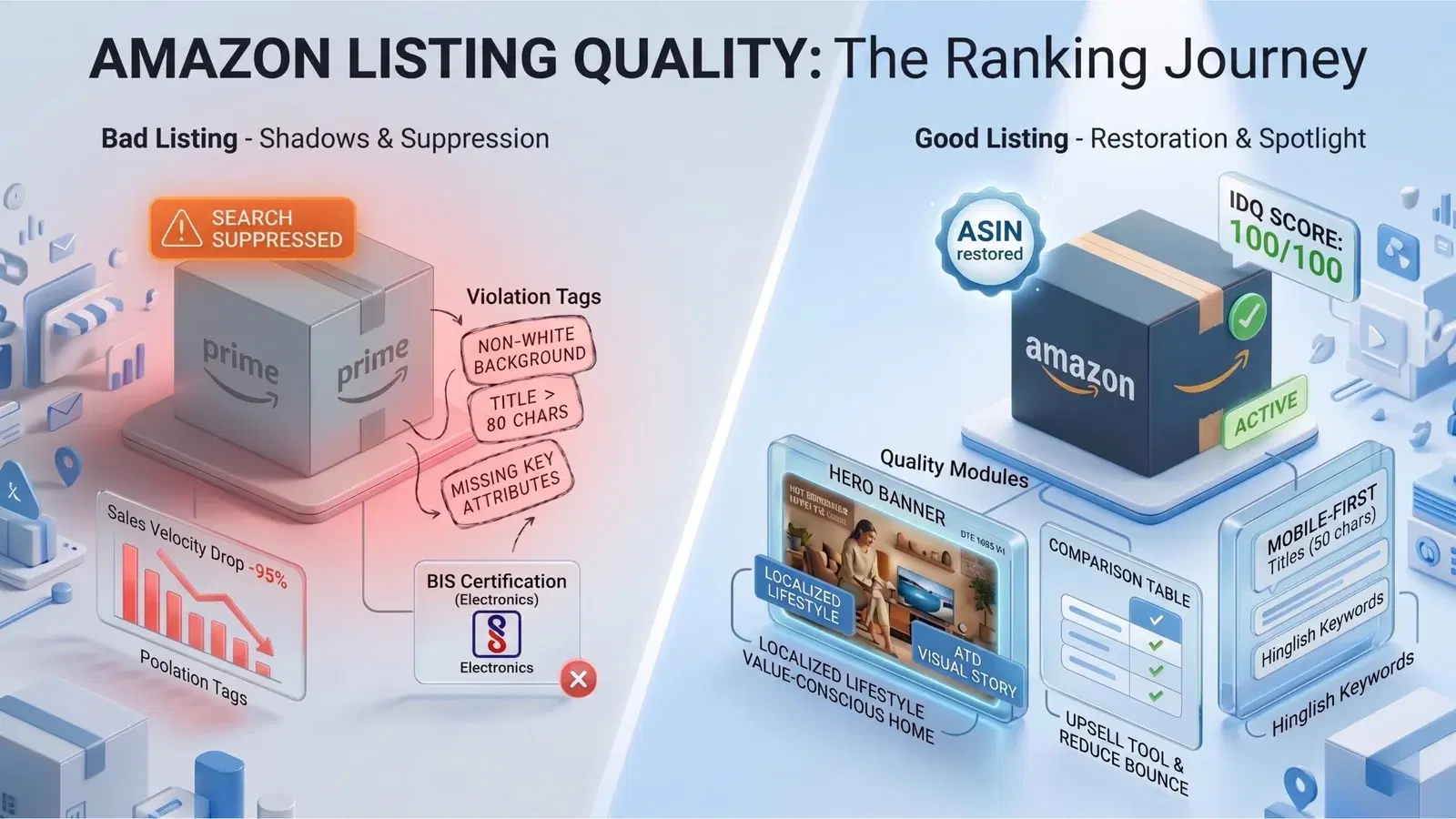
Image issues are the single most frequent suppression cause across all categories on Amazon India. The main image requires a pure white background — exact RGB 255,255,255. Off-white pixels from shadows or automated background removal tools trigger the compliance system. Amazon updated its image detection bots in 2024 to flag AI-generated image edits more aggressively, meaning images that passed before 2024 may fail now. Listings with fully compliant, high-quality images also convert at meaningfully higher rates — making image quality a revenue issue, not just a compliance one.
In practice on Amazon India, text and logo detection is an equally — often more — common suppression trigger than background colour alone. Amazon's image compliance system (Error 18027) flags any main image containing text overlays, brand logos, promotional badges, certification stamps, or watermarks as a policy violation. Many sellers add these elements to the main image believing they drive conversions — they can, but only on secondary images, where they are permitted. On the main image they trigger suppression. Listings that cleared compliance checks before Amazon's 2024 image AI update may now fail the current detection standard, making a main image re-audit a worthwhile exercise even for long-active ASINs.
Missing Mandatory Attributes
Any empty mandatory field — brand name, size, colour, material type, item weight — today more commonly prevent a new listing from going live at all, or surface as suppression during a listing edit when the algorithm runs a full compliance re-validation across all fields. It is the edit event that typically fires the check — not a background enforcement sweep. The practical implication: any catalogue update is a potential compliance event, which is why a post-change review is essential every time a listing is touched. Title length violations are among the most commonly missed triggers: over 200 characters for most categories, or 80 characters for clothing and accessories. Amazon scaled enforcement on title formatting in Q2 2025, with many sellers only learning their listing had gone down after it was already invisible in search.
Pricing Violations and Restricted Category Issues
Amazon monitors prices across channels in real time. On Amazon India, a listing is not directly suppressed simply because your price is higher than Flipkart or your own website. What happens instead is a Price Competitiveness impact: Amazon's system flags the gap under the Price Competitiveness metric, and the listing loses its Featured Offer (Buy Box) eligibility. That triggers the same downstream cascade as suppression — lower sales velocity, weaker organic rank, reduced visibility, higher ad spend to recover lost ground. Cross-channel price parity is non-negotiable on Amazon India: it determines where your listing ranks in search, not just whether it appears.
One pricing scenario that does trigger direct suppression on Amazon India: a sudden, sharp price change on Amazon itself. A price increase or drop beyond Amazon's acceptable internal threshold — practitioners commonly cite around 10%, though Amazon does not publish the exact figure — can flag the listing under Amazon's Fair Pricing Policy and result in a Potential High Price Error, deactivating the listing until the price is reviewed or corrected. In gated categories — health, electronics, food, baby products, cosmetics — listing without FSSAI, BIS, or CDSCO certification triggers automatic suppression on Amazon India. Submitting expired documents has exactly the same result as submitting nothing.
Hazardous Goods (Hazmat) Non-Compliance
Products containing lithium-ion batteries — power banks, mobile accessories, Bluetooth devices, electric grooming tools, torches — and items with flammable chemicals, aerosols, or pressurised contents are subject to Amazon India's Dangerous Goods (DG) review process before they can be listed or remain live. If Amazon's system detects that a product requires Dangerous Goods classification but has not cleared the required review, or if the submitted exemption documentation is incorrect or incomplete, the ASIN is moved to Hazmat review status and suppressed from search. This affects a broader range of products than most sellers expect: spray-based cleaning agents, aerosols, any item shipped with a Li-ion cell, and products flagged by Amazon's chemical detection AI. Correctly completed Safety Data Sheets (SDS) or battery exemption forms are mandatory, and incorrect submissions extend reinstatement timelines significantly — sometimes weeks, not days. On Amazon India, re-submitting corrected DG documents through Seller Central is the only path to reinstatement; Seller Support cannot override a Hazmat suppression.