Amazon Seller Strategy
Get Ready for Prime Day and Amazon India Sales: The 2026 Seller Checklist
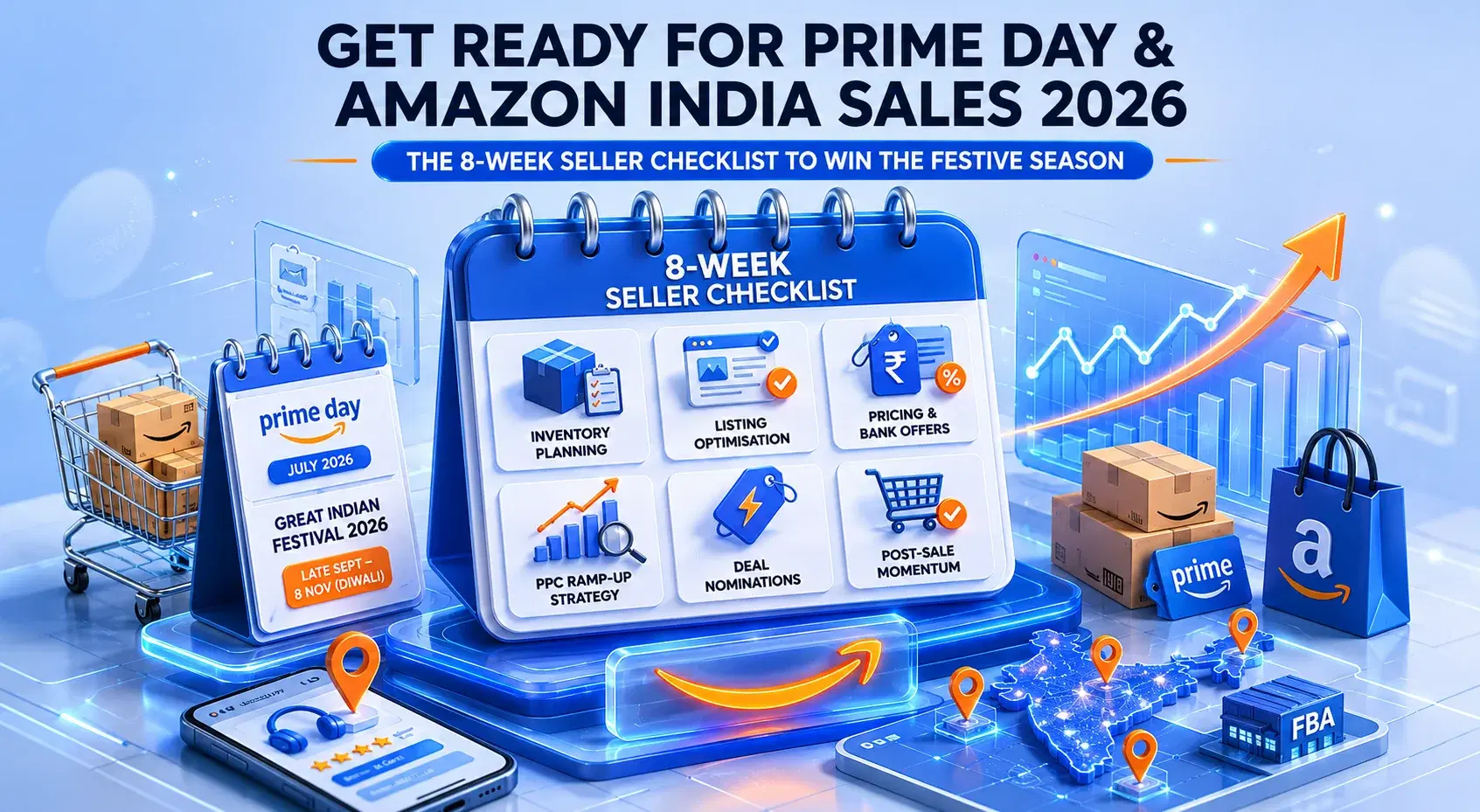
Get ready for Prime Day India 2026 and the Great Indian Festival the smart way: with a written checklist that starts eight weeks before the event opens.
Key Takeaways
Start prep eight weeks before any major Amazon India sale event.
Lock pricing first — deal eligibility depends on the 30-day lowest price rule.
Stack bank offers, Lightning Deals, and Prime Exclusive Discounts for compound savings.
Ramp PPC 25–40% the week before — never just on Day 1.
Treat the 7–14 days after the sale as a separate prep track, not a wind-down.
Introduction
Get ready for Prime Day India 2026 and the Great Indian Festival the smart way: with a written checklist that starts eight weeks before the event opens.
Sellers who plan ahead walk away with record numbers. Amazon India recorded 276 crore customer visits during AGIF 2025, roughly double the 140 crore visits of 2024, with 70% of first-48-hour traffic coming from beyond the top 9 metros. Sellers who improvised lost the buy box, ran out of stock, or burnt their ad budget by Day 3.
This checklist covers the six tracks that matter including inventory, listings, pricing, ads, deals, and post-sale momentum and when to run each.
Get Ready for Prime Day with an Inventory Plan That Covers Tier 2 & 3 Demand
Your Amazon inventory management strategy decides whether you capture the upside or watch competitors take it. With 70% of AGIF 2025 first-48-hour traffic coming from beyond the top 9 metros, a forecast built on last year's averages will run out.
Start eight weeks before the event. Pull your last two festive cycles from Seller Central and look at velocity by region, not just total units. Tier 2 and 3 cities drove 21% YoY growth in health and wellness alone during AGIF 2025, stocking only metro fulfillment centres leaves the fastest-growing segment underserved.
Split your top 5 SKUs by FBA fulfilment centre, set a Low-Inventory-Level alert at 14 days of cover, and replicate stock to at least three FCs covering north, west, and south India. Amazon added 12 new fulfilment centres and 45 new delivery stations before AGIF 2025 capacity sitting exactly where demand is growing.
How to Optimize an Amazon Listing Before Festive Traffic Arrives
Knowing how to optimize an Amazon listing is the difference between paying for clicks that convert and paying for clicks that don't. During AGIF 2025, over 16,000 SMBs tripled their daily sales in the first 48 hours but only on listings ready before traffic arrived.
Start with the title. Amazon India enforces a 200-character maximum across most categories, with mobile viewports rewarding titles under 80 characters. Apparel is capped at 125 characters including spaces. Front-load your primary search term in the first 40 characters, follow with brand and key benefit, end with size or pack quantity. Most sellers waste the first 40 characters on the brand name and fix that single line before anything else.
Then add Hindi-romanised and regional search terms to your backend search-term field, which Amazon India caps at 200 bytes. Roman-script Hindi like "kadhai non-stick" alongside "non-stick wok" captures searches that English-only keywords miss.
Bullets come next: five bullets, 150–200 characters each, leading with the use case, not the spec sheet. Then images seven plus a video, with the second image showing the product in a real Indian context, not a sterile white background.
A+ Content rounds it out. Listings using A+ Content see 3–10% higher conversion rates. If you're Brand Registered, set up your Brand Story module once it appears on every ASIN in your brand. During festive periods, comparison-chart modules work especially well.
Lock Your Pricing and Stack Bank Offers Before the 30-Day Window Opens
Your Amazon seller pricing strategy for festive events has one non-negotiable constraint: the 30-day lowest price rule. Amazon's deal eligibility Lightning Deal, Best Deal, Deal of the Day requires your offer to be at least 20% below the lowest price in the previous 30 days. Discount in the lead-up week to "build momentum" and you've just disqualified your own SKU.
Lock your festive price six weeks before the event. Calculate backwards: take your intended sale price, add 25%, and that becomes your floor for the preceding 30 days. Any tactical discount inside that window even a 10% coupon resets the average and breaks deal eligibility.
Next, bank offers. Amazon India's biggest events typically feature 10% instant discounts via SBI, ICICI, HDFC, or Amazon Pay ICICI Bank cards, and the bank funds it not the seller. Aligning your festive price with these offers creates the stacked discount customers see: 10% bank + your seller coupon + Prime Exclusive Discount, with you funding only two of the three.
The third piece is GST. AGIF 2025 ran a "GST Bachat Utsav" framing after rate cuts on multiple categories if your category was affected, customers expect the pass-through reflected. Pull your 30-day price history per SKU, set your festive floor, and confirm bank offers with your account manager before touching deals or PPC.
Let Your Product Page Do The Selling
Try EcomBuddhaBuild a Festive Holiday PPC Strategy That Ramps Up — Not Burns Out
A festive holiday PPC strategy is not the same as your everyday campaigns. The biggest mistake we see Amazon India sellers make is doubling their daily budget the morning the sale opens, watching ACoS spike, and pulling back by Day 3. By then the algorithm has learned that your campaigns under-perform under competition, and your organic rank suffers for weeks.
The right ramp starts seven days before the event. Increase budgets 25–40% during the lead week, push high-converting branded and category keywords, and let the algorithm feed on fresh conversions before peak hits. Sponsored Products does most of the work 74% of third-party sellers use it but Sponsored Brands and Sponsored Display matter more at peak because they capture comparison-shoppers and retarget bounced viewers.
During Days 1–3, push budgets 2–3x on your top 5 keywords per SKU not across the entire account. Concentrate spend where you already convert. Prime Day India 2025 saw orders peak at 18,000 per minute, a 50% jump over 2024 that volume rewards focus over breadth.
Defend your branded keywords with exact-match Sponsored Products. In the seven days after the sale ends, do not switch off ROAS often runs higher because organic momentum stays elevated while competitor spend drops. Maintain 70–80% of peak budget for one full week.
Stack Your Deals: Lightning Deals, Coupons, and Prime Exclusive Discounts
Setting up a lightning deal is one of the few levers that gives your listing three things at once: a deal badge, a slot on the Today's Deals page, and a temporary ranking boost. Most sellers either skip this or submit the week before the event too late. Lightning Deal slots for major events fill up six to eight weeks in advance.
Submit in Seller Central two months before the event. Pick a hero SKU with a 4.0+ rating, at least 30 reviews (5+ for less competitive categories), and consistent buy-box ownership. The discount must be at least 20% below the 30-day lowest price which is why pricing gets locked first.
Stack a Prime Exclusive Discount on top of the Lightning Deal. The PED triggers a coloured badge that helps your SKU stand out. For SKUs that don't qualify, layer a 10% seller coupon with a 10% bank offer a visible 20% stacked discount, with the bank co-funding half.
If you're Brand Registered, use Amazon's Virtual Bundle tool. Bundles of one hero plus one complementary SKU consistently lift average order value during festive weeks, especially in beauty, home, and kitchen.
Sustain the Momentum: How to Increase Amazon Sales Rank After the Sale Ends
The week after a major sale event is where most sellers leak revenue. Brands that increase amazon sales rank for the rest of the quarter treat post-event as a separate prep track, not a wind-down.
Three things matter in the seven days after the sale closes. First, send a Request a Review through Seller Central or Buyer-Seller Messaging to every order placed during the sale window. Review velocity in the 14 days post-event compounds organic ranking for the next quarter.
Second, replenish FBA inventory the day the sale ends. Amazon India recorded 1.4 crore same-day deliveries during AGIF 2025, up 60% year-on-year (Amazon India, 2025), and stockouts in this window kill the organic rank you just earned.
Third, run a Day-by-Day report in Seller Central and identify which SKUs gained organic rank during the event. Push 70–80% of your peak ad budget at those specific ASINs for the next 14 days. In our work with Amazon India sellers, holding velocity for two weeks after the event is what locks in festive ranking gains for Q1.
Conclusion
Every Amazon India seller has the same 30–40-day window; the festive shopper has only the prepared ones exit October November with velocity and ranking gains that hold into Q1. The six tracks above each have a specific timeline and a specific action.
Frequently asked Questions

Naveen Kumar Nutheti is a seasoned e-commerce strategist with 12+ years of experience across India and the Middle East. He has scaled businesses past ₹1,000 Cr in annual revenue and consults brands including Godrej, Nippon Paint, Kohler, Havells, Taparia, and Birla Opus on e-commerce sales strategy and product listing optimisation. He is the founder of EcomBuddha, an AI-powered listing intelligence platform for Amazon India sellers.
Audio Blog
0:00
Table of Contents
See how EcomBuddha can grow your Amazon India business.
Related Blogs
Amazon 101
FBA Full Form: What Amazon FBA Means, How It Works, and Whether It's Right for Your Business in 2026
8 April, 2026
Amazon Seller Strategy
Amazon Private Label 2026: How to Build Your Own Brand and Grow on Amazon
6 April, 2026
Amazon 101